
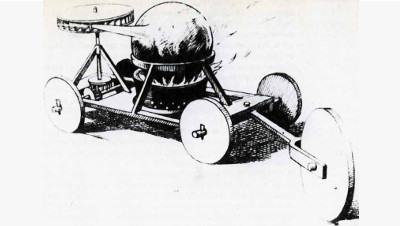
In 1672, a Flemish missionary in China, Ferdinand Verbist, designed a steam engine that could propel a toy self-propelled apparatus. The first 60 cm of the way the prototype overcame in 1679 in the gardens of the Imperial Palace in Beijing and caused great admiration of the ruler. This car did not carry passengers, but it got into history as the first car with steam engine (pictured is Ferdinand Verbist's steam engine in 1678).
The story of the invention of the steam engine begins in the first century AD in Egypt. Heron Alexandrian described a device called "aeolipil". It was a ball filled with boiling water, with nozzles fixed at it, bent at right angles. The ball rotated under the action of jet forces caused by steam exiting the nozzles.
The real steam turbine was invented in the 16th century by the Arab philosopher, astronomer and engineer Tagi al-Din. This engine had the appearance of a spindle equipped with vanes rotating under pressure of the steam directed at them. A similar device was proposed by the Italian engineer Giovanni Branco in 1629. The main disadvantage of these inventions was the high energy consumption due to the scattering of steam flows, so they did not find practical use.
Information sources and literature:
- https://en.wikipedia.org History of the automobile. 2019-01-24.
- http://www.christusimperat.org Перший автомобіль сконструював єзуїт?. 2019-02-05.
- http://moyaosvita.com.ua Як винайшли паровий двигун. 2019-01-24.
It is believed that the first steam self-propelled vehicles capable of carrying people and luggage were developed in the late 18th century. Nicolas-Joseph Cunho is the world-renowned inventor of the first full-size self-propelled mechanical machine. His creations include a tricycle and two steam tractors designed specifically for the French army, one of which is kept in the French National Museum of Arts and Crafts.
The development of the car began in 1764, when Cugnot received an official commission from the French Minister of War, Marquis de Chouazel, to create a steam tractor for artillery. In October 1769, Cugnot demonstrated his car in Paris for the first time. It was a three-wheeled cart with a boiler and two pistons placed on the front wheel and rotated with it. In order to heat the water, the fire was ignited in a stove under the boiler, and when the water boiled the machine set off. Steam boiler load was enough for 15 minutes. Then again the boiler had to be filled with water and a fire was lit under it.
Steam vehicle evolved power of about 2 hp. and could carry up to 3 tons of cargo at a speed of about 4 km/h. The engineer himself called his apparatus a "fiery cart".
Information sources and literature:
- http://tbauto.org The world's first self-propelled vehicle. 2019-01-28.
- https://books.google.com.ua Основы конструкции современного автомобиля. 2019-01-28.
The first attempts to manufacture an internal combustion engine started in VIII century. and were complicated by the lack of an appropriate type of fuel, especially liquid, and early engines used a gas mixture.
In 1806, a Swiss engineer, Francois Isaac de Rivas, assembled an engine that worked on a hydrogen-oxygen mixture. Samuel Brown, an Englishman, experimented on his own hydrogen-fueled engine in 1826, and in 1859 Etienne Lenier created the first working example of an internal combustion engine. Around 1870 in Vienna, because of explosion of unintentionally burned air mass with a high concentration of gasoline vapors inventor Siegfried Marcus was enlighten with the idea of using gasoline as a fuel. Creating the world's first gasoline-powered engine, he placed it on an ordinary cart and became the first person who filled his car's tank with liquid fuel. Today, this vehicle is known as the "first Marcus machine".
In 1879 the German inventor Carl Benz designed a two-stroke internal combustion engine, and later, in 1885 in Mannheim, Benz built his first car (pictured three-wheeled Benz' Motorwagen), for which in a short while he obtained a patent and began serial production of automobiles.
Information sources and literature:
- https://interestingengineering.com 20 Greatest Innovations And Inventions of Automobile Engineering: From the First Engine to Today. 2019-01-29.
- https://uk.wikipedia.org Історія автомобіля. 2019-01-30.
- https://sites.google.com/site/cucasnimasini Перші машини. 2019-01-31.
Before the invention of the electric starter, cars started with the help of a crank, which was extremely inconvenient, difficult and dangerous, since many cars at that time did not have a neutral transmission, so when rotating the crankshaft, the car started to move right at the driver, and when the engine started he had to catch to jump into his self-propelled carriage on the go.
In 1911, inventor from Ohio, Charles Kettering, starts work on a project that later on will bring him worldwide fame and vice presidency at General Motors. This project was called "electric starter for starting a car engine". On June 15, 1911, Charles Kettering presents his invention - an electric motor that in a short period of time evolved enough power to spin the engine crankshaft to the required speed, and after starting the same electric motor was used as a generator to charge the battery.
The first to appreciate this important invention was Henry Leland - founder of the Cadillac car giant. And in 1912, the production of Cadillac Model Thirty (pictured), which became the first car in the world with an electric starter and headlights, is launched into mass production.
Information sources and literature:
- https://infokava.com Підступність заводної ручки або історія винаходу стартера. 2019-02-01.
- http://motorglobe.org Электрическому автомобильному стартеру 105 лет. 2019-01-30.
In the second half of the XX century car design has experienced revolutionary changes in the type of pontoon body (without protruding wings and their rudiments, car lifts and headlights). During the 1950s, engine power and transport speed increased, constructions became more integrated, and cars were distributed worldwide.
The small Mini (pictured Mini released in 1959), designed by Alec Issigonis, considered the iconic British car of the 1960s, first produced in 1959, immediately captured a significant portion of sales in many countries. Almost everything in the new car was embodied for the first time, including the transmission integrated with the oil sump. The combination of the front drive with the transverse arrangement of the engine allowed to produce a car with a body length of 3 meters while maintaining the volume of the cabin. All this has brought Alec Issigonis a reputation as a genius, and his work has gained worldwide popularity.
The rapid increase in popularity of Alec Issigonis's creations was not affected even by the fact that in the first year of exploitation of newly made cars, a number of serious defects were identified, the main one was poor interior waterproofing. During the rain, water immediately penetrated through the cracks inside the cabin and turned the mats into pallets for puddles, creating the effect of driving a roofless car. By the way, according to one of the legends, it was Mini who inspired designer Mary Quant to create a mini skirt.
Information sources and literature:
- https://uk.wikipedia.org Історія автомобіля. Процитовано 2019-02-04.
- https://mini.infocar.ua Mini. Большая история маленького автомобиля. Процитовано 2019-02-04.
Many people consider the father of electric cars the eccentric inventor Ilon Musk, who in 2008, together with Tesla Motors, launched his first world-famous Roadster, which later became the first private wheeled vehicle to travel in space. This elite sportcar had a "tank" of 320 km and became an ideal for carmakers who worked on their models of electric vehicles.
In fact, the development of the electric vehicle industry began even before the invention of the internal combustion engine. Early prototypes and true tractors of several horsepower started to appear in the XIXth century, from 1828. Initially, the power reserve and speed of electric cars and gasoline crews were about the same, but due to problems with battery charging, electric motors only had to wait for their day.
And that day came in 2010 with the start of the massive production of Nissan Leaf electric cars (pictured), a model that already had an affordable price, could travel up to 175 km on a single charge and become the best-selling model in the world as of December 2015. Further expansion of electric transport is also facilitated by rising prices on oil, environmental problems and building a network of charging stations for the future generation of cars.
Information sources and literature:
- https://nachasi.com Коротка історія електромобілів у світі. Процитовано 2019-02-10.
- https://interestingengineering.com A Brief History and Evolution of Electric Cars. Процитовано 2019-02-11.
(I) It is quite possible that we will see flying cars in the near future. Recently, the world's first mass-produced flying car Terrafugia has went up into the sky. And not only went up, but even flew and landed safely. Terrafugia turns from car to plane in 30 seconds. It is driven by hybrid engines, accelerating to 104 km/h on earth and up to 185 km/h in the air.
(II) Due to the fact that the population of large cities is growing at high speed, recently more and more cars appear on the roads. That is why compactness and maneuverability of cars will be appreciated in the future.
(III) Most future cars will be driven by autopilot. Last year, dozens of companies presented their self-driving car concept, including a steering wheelless car. Note that the concept of "self-driving" in many cases is exaggerated, since not all cars can completely go without the driver's control. The comfort of the cars will also increase, allowing the driver to be as focused on the road as much as possible. Already today, modern cars from leading manufacturers are equipped with a large number of electronic systems required for a comfortable and safe ride.
Information sources and literature:
- http://hi-news.pp.ua Автомобіль майбутнього - яким він буде? Технології майбутнього. Літаючі автомобілі. 2019-02-04.
- https://futurum.today Якими ж будуть автомобілі майбутнього…? 2019-02-05.
- https://uk.etcetera.media Автопілот і електрика: якими будуть автомобілі у найближчому майбутньому. 2019-02-07.